

 0
0
 0
0
Avery Bad Translation
It all started with the Pirate King. To understand how we lost one of the most tactically fascinating military units in history, we have to look back to the seventeenth century and the infamous English pirate Henry Every—sometimes recorded as Avery or “Long Ben”. When Every’s pirate coalition captured the Ganj-i-Sawai, a massive treasure dhow belonging to the Mughal Emperor Aurangzeb in 1695, the ensuing melee with warrior women collided with a profound cultural blind spot. Retelling of the pirate assault dismissed these formidable defenders as “harem women armed with swords,” completely erasing a centuries-old institution of warrior women who formed the innermost line of defense for the wealthiest rulers on earth.
The reality of the zenana was not a stagnant playground, but a self-sufficient, highly cosmopolitan administrative city housing upwards of 5,000 noblewomen, officers, and attendants under the grand design of Emperor Akbar. Because the practice of purdah strictly forbade unrelated adult males from entering these private chambers, the physical safety of the palace fell entirely upon female administrators and guards. Since the Mughal emperors spent a massive portion of their leisure time within the zenana, these female warriors—known as the Urdubegis—were trusted with the ultimate responsibility: preservation of the sovereign’s life.
No Veil, No Surrender
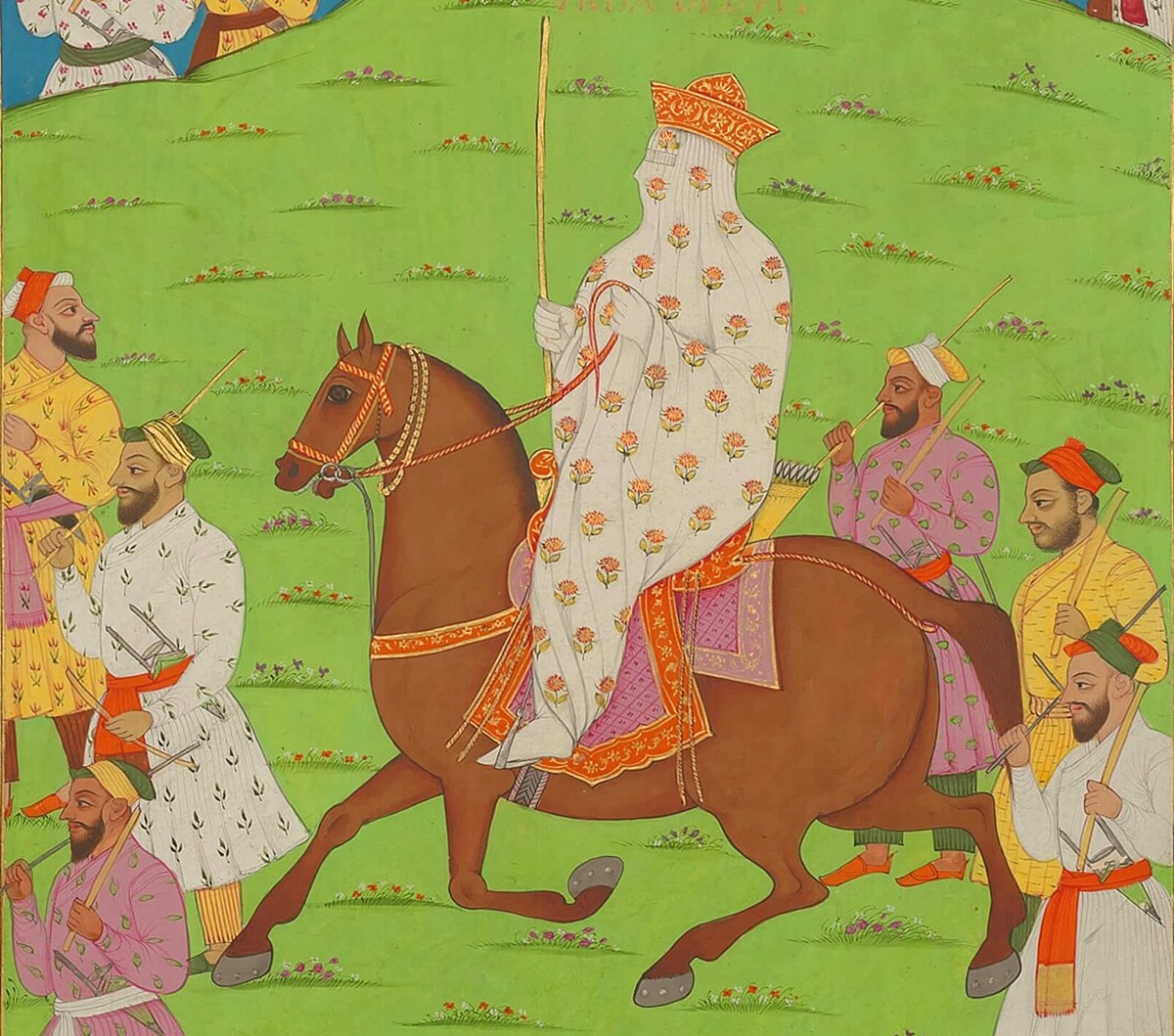
To build an effective shield around the emperor, the Mughal court turned recruitment into an art of tactical alienation. Rather than pulling guards from local noble families who might harbor political ambitions or family loyalties, the Urdubegis were recruited from foreign and non-local groups, including Abyssinian (Habshi), Tatar, Turk, and Kashmiri communities. Crucially, they were selected from cultures that did not observe purdah, meaning they were accustomed to moving freely and unhindered by veils. This lack of restriction allowed them to act as highly visible travel escorts, managing the complex logistics and safety of the imperial family during outdoor excursions, hunts, and dangerous military campaigns.
From childhood, these women underwent rigorous training in martial arts. They were proficient in both long-range and close-quarters weaponry, utilizing heavy composite bows, lances, short daggers, and specialized swords (the talwar, bana, and khanda) with lethal precision. During the early reigns of Babur and Humayun, when the empire’s borders were constantly shifting and the court lived in mobile military encampments, the Urdubegis kept guard right outside the royal tents, regulating entry and acting as the primary intelligence gatherers of the camp. They were so formidable that even the royal family feared their wrath; during a brutal war of succession, Prince Aurangzeb famously refused to visit his ailing father Shah Jahan because he was terrified the female guards of the zenana would execute him.
While court histories written by male scribes rarely named these warriors, the remarkable Humayun-nama—penned by Humayun’s half-sister, Gulbadan Begum—names the legendary Bibi Fatima. Originally a royal wet-nurse, Fatima proved her absolute loyalty and tactical cunning so thoroughly that Emperor Akbar promoted her to the chief of the Urdubegis, placing her in charge of the entire inner security apparatus. Under Akbar’s vision, this defense was organized into three highly disciplined, concentric rings to prevent any single point of failure. At the outermost perimeter stood the heavy Rajput cavalry and the specialized Ahadi gentlemen-at-arms. The middle tier was manned by watchful eunuchs who controlled the physical gates and administrative boundaries. But if an assassin bypassed both, they stepped into the innermost ring: the private chambers, where the Urdubegis patrolled with notched bows and unsheathed steel. To ensure absolute alertness and prevent internal conspiracies, the entire guard staff was rotated every twenty-four hours.
Purdah and Initiative
The Urdubegis make incredible NPCs, patrons, or adversaries in a campaign. Because they were highly trained in martial arts, archery, and diplomacy, and were the only armed forces permitted inside the private royal quarters, they operated at the intersection of deadly combat and high-stakes espionage. Here are three adventure hooks to integrate them into your campaign:
- The Poisoned Zenana. An assassination attempt has been made on the Empress inside the forbidden palace grounds. Because no men are allowed within the inner walls, the Sultan’s regular army and male investigators are prohibited from investigating the crime scene. The Captain of the Urdubegis secretly recruits the party to act as external operatives. While the Urdubegis lock down the palace and interrogate the court from the inside, the PCs must hunt down the rare beast used to harvest the poison in the outside world. The players discover the poison was bought by a rogue Urdubegi who has been compromised by a rival faction, forcing a tense, high-stakes confrontation within the palace barracks.
- The Diplomatic Shield. A high-ranking princess is traveling across dangerous, monster-infested borderlands to negotiate a crucial peace treaty. A detachment of Urdubegis is assigned as her primary vanguard and personal shield. The Urdubegi commander hires the adventuring party to serve as a decoy convoy or heavy frontline support to handle the larger, monstrous threats (like drakes or giants) while the warrior women manage close-quarters defense and political espionage. The “princess” traveling with the Urdubegis is actually a body double—one of the warrior women themselves—while the real princess is disguised as a low-ranking guard. The party must maintain the ruse even as assassination attempts grow increasingly lethal.
- Vault of the Fallen Dynasty. A magical coup has overthrown the central empire, and the capital has fallen into the hands of a treacherous vizier. The regular military has surrendered. The players are approached by a battered but unbroken squad of surviving Urdubegis. They have successfully smuggled the infant heir out of the palace, along with the keys to the royal treasury, but their commander was left behind. To secure the heir’s safety and fund a rebellion, the party must infiltrate the occupied capital alongside the Urdubegis, utilizing the secret, hidden passages of the zenana that only the warrior women know exist.
Stranger Than Fiction
History is the ultimate resource for any game master looking to inject cultural depth into their campaigns. The Urdubegis challenge assumptions and provide context for a society of warrior women, be it as backgrounds, allies, or foes. They’ll be showing up in my campaign soon enough, searching for Every’s buried treasure.
Your Turn: What cultures do you use as inspiration for your warrior women?