
 0
0
 0
0
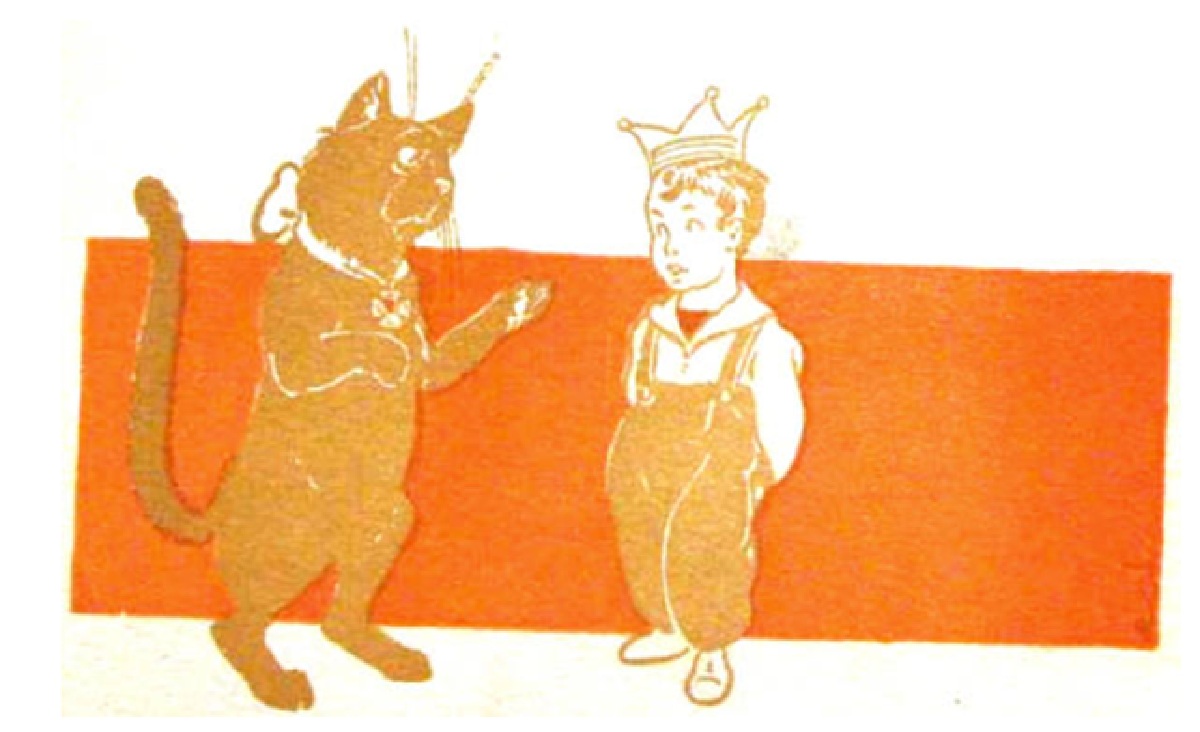
In the 1901 novel Dot and Tot of Merryland, written by L. Frank Baum and illustrated by W.W. Denslow, the fifth valley—known as the Valley of Pussycats—presents a highly structured society populated entirely by cats of every color and breed. It’s run by the aristocratic court of King Felis, the large Maltese cat who rules the valley.
Dot and Tot in Meow-yland
The physical layout of the valley, as detailed in the canonical lore of the Valley of Pussycats, contains exactly 47 whitewashed boxes, each featuring a protective railing around the flat roof and a single door positioned in the center of one side. Crucially, these doors are constructed nearly as high as a human child’s chin, presenting a humorous spatial challenge for medium-sized adventurers who must climb head-foremost into the structures. Inside these houses, such as Cousin Tabby’s house (number 16), the environment is scaled for felines, featuring soft carpets, scattered cushions, low tables no higher than an adventurer’s knee, and small white bowls of milk.
In the middle of the night, they all sit upon these railings and have a grand concert, with the house that can produce the loudest chorus and the most varied sound considered the most aristocratic in the Valley. Queen Dolly herself isn’t particular fond of the place for this reason:
“Well, I wouldn’t,” rejoined the Queen. “The last time I passed the night in this Valley the pussys screamed so loudly at their midnight concert that the noise cracked my wax. They are much nicer to visit in the daytime.”
These Boots Were Made for Talking
The cats in the valley seem to easily shift between standing upright and walking on all fours, a long tradition established with the ur-text of all clever cat stories, Puss in Boots.
The narrative of Puss in Boots first appeared in print between 1550 and 1553 under the title “Costantino Fortunato” (Lucky Costantino). It was written by Italian author Giovanni Francesco Straparola and published in his dark, bawdy anthology The Facetious Nights (AKA The Pleasant Nights).
The story begins with a poor Bohemian mother on her deathbed. Instead of a mill, she leaves her three sons a kneading trough, a pastry board, and the family cat. The youngest son, Constantino, laments his seemingly worthless inheritance. However, the cat—who wears no boots in the story—reveals herself (a female cat!) to be a powerful fairy in disguise who vows to make Constantino rich. To catch the attention of the King of Bohemia, the unnamed cat uses her predatory feline instincts to hunt wild rabbits. She presents the rabbits to the King not as a humble offering, but as a grand tribute from her master, “Lord Constantino,” whom she falsely describes as a reclusive nobleman.
The cat then puts the next stage of her plan into action: she discovers the King’s royal carriage route and commands Constantino to strip naked and jump into the river just as the entourage passes. She frantically screams to the King’s guards that Lord Constantino was brutally mugged and beaten by brigands while traveling to bring gifts to the palace. The King, recognizing the name from the rabbit tributes, immediately rescues Constantino, clothes him in royal garments, and introduces him to his daughter, the princess.
As the royal carriage travels toward “Constantino’s lands,” the cat sprints far ahead along the road. She encounters various peasants, farmers, and shepherds tending to vast fields. The cat threatens them, stating that a massive band of mercenaries is coming to slaughter them all unless they explicitly tell the passing King that all the land belongs to Lord Constantino. Terrified, the peasants comply, leaving the King deeply impressed by the youth’s immense domain. The cat leads the royal procession to a luxurious castle that happens to be completely vacant because its previous lord had very conveniently just died without leaving an heir. The cat confidently declares the entire fortress to be Constantino’s ancestral home. The King is so overwhelmed by the sheer wealth that he marries the princess to Constantino on the spot.
When Charles Perrault rewrote the tale in 1697 under the French title “Le Maître Chat ou le Chat Botté” (The Master Cat, or Puss in Boots), he fundamentally reshaped the Italian folk story to fit the tastes, politics, and anxieties of the Court of King Louis XIV at Versailles. It was Perrault who gave the cat his iconic pair of leather boots, a grand sweeping hat, and a matching doublet, a sly jab at aristocratic wear. Perrault also invented a villainous, shapeshifting Ogre and the famous trick where Puss dares him to turn into a lion, then a mouse, before promptly devouring him to claim his castle … far more exciting than an empty castle of Straparola’s. I retold this story from the mouse’s point of view in my novel, Awfully Furmiliar (volume one in a trilogy).
Perrault also changed the miller’s son’s fake title to The Marquis of Carabas. “Carabas” was a satirical choice: a nonsense word likely derived from Karabas, a historic Turkish name, or a reference to a well-known eccentric figure from Alexandrian history. Perrault was mocking the trend of newly wealthy bourgeois Frenchmen who bought empty land just to give themselves grand, fake-sounding aristocratic titles to climb the social ladder at Versailles.
For modern audiences, Puss in Boots is best known from the Shrek franchise, most recently the latest film, Puss in Boots: The Last Wish (2022). Since his introduction in Shrek 2 (2004), Puss was defined as a hyper-confident, legend-obsessed swashbuckler who treated his mortality like an afterthought. In The Last Wish, he faces the terrifying realization that he has burned through eight of his nine lives, leaving him with only one remaining. This triggers a narrative shift from shallow myth-making to existential vulnerability.
The Dark, Fluffy Underbelly
There’s another popuar place where cats rule: H.P. Lovecraft’s Dreamlands mythos features Ulthar, a tranquil yet intensely unsettling village situated beyond the River Skai, governed by a sacred law: “No man may kill a cat.” The setting and its inhabitants are introduced across two primary stories, which establish a blend of cozy pastoralism and cosmic justice.
In The Cats of Ulthar (1920), an old cotter and his wife who took cruel pleasure in trapping and brutally murdering cats get their comeuppance when a little orphan boy named Menes loses his beloved black kitten and prays to an ancient Egyptian entity for revenge. That night, every cat in Ulthar vanishes, swarming the cotter’s cabin. The next morning, the cats return to the village plump and satisfied, refusing their usual food, leaving two cleanly picked, stark white human skeletons in the cotter’s cabin. Following this horrific event, the burgesses pass the famous decree against harming felines.
In The Dream-Quest of Unknown Kadath (1927), the protagonist, Randolph Carter, visits Ulthar and discovers that the town’s cats are actually an organized, hyper-intelligent global network. They possess their own military hierarchy, language, and the supernatural ability to leap directly from Earth’s rooftops to the dark side of the Moon. When Carter is kidnapped by toad-like Moon-beasts, the general of the Ulthar cats mobilizes a feline army on the Moon to launch a rescue operation, saving Carter out of respect for his lifelong love of cats (Lovecraft was clearly a fan of cats).
Purring it All Together
Adding all this up creates a foundation for an adventuring town of felines. Whether or not they all have nine lives, an Ulthar-inspired hierarchy is a powerful force that might look like a sleepy town on the outside but can be mobilized to battle zoogs and moon-beasts with interdimensional leaps. For catfolk characters, this can just as easily be their homeland; as NPCs, a regular cat might well have a secret life as a heroic swashbuckler who just happens to enjoy pets and treats.
Your Turn: Where do your catfolk come from?
The Merryland Series
These articles are published once a week, so depending on when you click through some of these may not be published yet.