
 0
0
 0
0
Ravenloft: The Horrors Within follows Van Richten’s Guide to Ravenloft, going deeper and providing more ideas and options. It also partially replaces VRGtR, which is a bit more tricky and possibly annoying.
During the press event for RtHW, the project’s creative team said that the difference between the two books is that VRGtR served as an introduction to horror for 5E players and DMs, with RtHW taking it to the next level. That includes new domains of dread, more info on how to run a horror campaign, and what happens when the player character becomes the monster while fighting evil. The last point is part of what “The Horrors Within” means.
One of the longest player/DM 5E hybrid books, RtHW contains:
-
4 Species
-
4 Backgrounds
-
7 Subclasses
-
11 Feats
-
17 One-shots
-
68 Monsters
-
288 Pages
-
47 Maps
-
2 Magic items
You might notice that I didn’t put the word “new” on those items. RtHW does contain new material, but it’s mixed with updated or revised content from VRGtR as well as Xanathar’s Guide to Everything. The rationale is that this puts everything together they may need for a D&D horror campaign, but it’s a no-win scenario for Wizards. Some fans, especially those new to D&D or deciding to dive into a horror campaign for the first time, are going to be happy to pick up one book instead of both RtHW and VRGtR. Those who already own VRGtR may be less favorably inclined to add the new book to their shelf, even if they do want the new and revised info. And VRGtR has some material, like the Horror Toolkit section, that is not replicated in RtHW. That’s a shame because I really liked the Horror Toolkit, especially its section on survivors.
Sinister Subclasses
Of the seven subclasses being hyped for RtHW, only two are new, the Hollow Warden Ranger and the Reanimator Artificer. The Bard College of Spirits and the Warlock Undead Patron both came from VRGtR. The Rogue Phantom is from Tasha’s Cauldron of Everything. The Grave Domain Cleric and Shadow Sorcerer are from Xanathar’s Guide to Everything. Putting them all together and tweaking them is handy but is sure to cause complaints I can’t fully dismiss.
And if Wizards is pulling together all of the horror-related or themed subclasses into one book for easy access, why not include the necromancer wizard class?
The Hollow Warden Ranger is a subclass for those who want to invoke folk horror. They can pull primal energy from the earth and call on ancient horrors from the land to sprout fangs or antlers. As a bonus action, you can transform for one minute to have ancient armor or have an unnerving aura or deliver prowling retribution. As you go up in level with this class and use its abilities, you gradually transform more and more. In protecting the land you love, you can easily end up losing yourself.
As the name indicates, the Reanimator Artificer allows you to create creatures, including a reanimated companion, through a blend of necromancy and science. In theory, this is awesome but calling it a “companion” can create the wrong impression. It only lasts until you take a long rest, at which point it collapses into a pile of viscera. It is somewhat like a gorier version of the Animate Dead spell, though the renaimated companion triggers a death burst when its time runs out or is ended early, causing 2d4 necrotic damage to those within 10 feet of the companion, half if they make a DEX save.
If hit by lightning, the companion ificer regains hit points equal to the damage the lightning would have caused. The reanimated artificer can do additional things, like improving the companion with strange modifications. In other words, they can take body parts from monsters killed and add them to their companion.
Basically, the Reanimated Artificer is great from a flavor perspective. I’m undecided about it mechanically since it disappears at the end of a long rest. I generally expect something labeled “a companion” to last a bit longer, even if the trade off is less power/damage dealt. Maybe it’s just semantics, but I think it would have bothered me less if it had been referred to as a Reanimated Minion, though that could conjure up very different mental images, like short, undead yellow guys named Dave.
Evolving Backgrounds
Perhaps a better example of how content in RtHW relates to what came before would be the backgrounds. Yes, RtHW has four backgrounds, the Haunted One, the Investigator, the Mist Wanderer, and the Spirit Medium.
The 5E Haunted One background first appeared in Curse of Strahd, granting skill proficiency (pick two from a list of four options), language, and equipment options in addition to the character hook/flavor. It also came with the Heart of Darkness Feature, suggestions for the Harrowing Event, and suggestions for bonds, ideals, and personality traits. In VRGtR, everything is largely the same, minus the suggestions for possible related personality traits, bonds, and idieals.
The RtHW version just gives you two skill proficiencies (no choosing), a tool proficiency (gaming), equipment options, ability scores (Constitution, Wisdom, and Charisma, and the choice of either the Survivor feat or a Dark Gift feat. I definitely like the upgrade, which is largely due to changes in the 2024 Players Handbook update, but it bothers me that the description of the Haunted One background is unchanged throughout the books.
On one hand, that’s fine if they feel it is the best description possible to explain it clearly in a short paragraph, avoiding confusion or manipulation, changing it would be silly. On the other, it feels like a bit of a cheat, despite the mechanical changes, and especially rubs me wrong since creators who worked on prior books are not specifically credited. Instead there’s a general thanks to the writers of VRGtR without naming them. The Haunted One originated in CoS, and Laura Hickman and Tracy Hickman are thanked, but that’s likely more for creating Ravenloft overall, and the CoS adventure than that particular background.
The Mist Wanderer background is for someone plucked from the mists and brought to Ravenloft. The Mist Walker Dark Gift Feat is recommended to go with this but not required, though it does support the option of someone wandering between the various domains of dread, seeking a way home.
The Spirit Medium background allows you to be a conduit for the spirits of the dead or damned, which can grant prescient insight, but at a cost. The Gathered Whispers Dark Gift Feat is recommended. Honestly, both of these backgrounds fit so naturally with Ravenloft I’m surprised we didn’t get some version of them sooner. The last option, the Investigator, originally appeared in VRGtR, and like The Haunted One, it has been updated.
I’ve never been a fan of feats so I didn’t love the switch to granting them as part of backgrounds. For RtHW, it makes sense that Dark Gifts would be an option instead of or a substitute for feats, but I don’t love that either. I preferred the approach in VRGtR where players worked with their DM to determine if one was appropriate and if so, how to work in rather than everyone getting one. On the surface, it seems more fair if everyone gets one, but Dark Gifts, unlike Origin Feats, come with a drawback that can be triggered on a bad die roll.
For species, the Dhampir, Hexblood, and Reborn previously appeared in VRGtR. I do like the addition of the Lupin. These PCs cannot shape-change but rather are stuck in a wolf/humanoid hybrid form that grants darkvision, improved might, and a howl that provokes dread. It’s a good alternative to the brutal loup garou or standard werewolf.
And if you really want to dive deep into all things Ravenloft, you can play a Lupin Mist Wandering Hollow Warden or whatever combination you like.
Revised Material
If you already read VRGtR, some of the advice on how to run a horror game, the domains of dread, the darklords, etc., in RtHW will sound familiar. Other than descriptions of previously printed character options like backgrounds, character classes, etc., everything I found in a side-by-side comparison of the books showed rewritten material, not exact duplicates.
The revisions mostly shortened and tightened up the content. That’s not necessarily bad since it freed up space for new content and art, but in a few examples the revisions felt a little flat. Overall, though, the revisions are fine, if somewhat disappointing.
A New Tarokka Deck for 2026
The 2016 Tarokka deck had black-and-white, Gothic-inspired artwork by Chuck Lukacs. The new deck, created by a number of artists, is full color, using the same saturated, unnatural color scheme used in the book. I think that if you use this Tarokka deck as a prop in your campaign, this new deck will not just catch your players’ eyes across the table but also easily capture their imaginations.
I like that RtHW includes guidance on how to stack the deck to make a reading turn out the way that works for your campaign as well as what to do if you forget what a card means so you don’t have to pause and look it up.
The cards can also be a mist talisman to travel between realms since each domain of dread has an associated Tarokka card. Each darklord also has a Tarokka card association as well as an opposing card.
If a Tarokka reading is performed for players while in a domain and the card opposing that domain is drawn, the darklord of the domain players are currently in can choose to see through the tTrokka reader’s eyes and even speak for 1 minute. While the Tarokka reader will have no memory of this possession, it provides an opportunity for the darklord to make threats or lie about the cards’ interpretation, both of which can be great fodder for the DM.
There’s further advice on how to use the cards for foreshadowing events and how to do card readings that serve the story. How to focus on card imagery, provide contextual meanings and more are detailed as ways to improve immersion.
Delving Into Domains
RtHW has more domains, but they’re not all created equal. Barovia is always prominent since it’s the domain that kicked off Ravenloft as a setting and is the most popular. The new domains get attention, of course, but like VRGtR, it only touches some domains lightly.
Last time, Bluetspur, The Carnival, I’Cath, and Richemulot had their own, larger entries. Now they’re relegated to the “other domains” section to make way for Innsmouth, Sithicus, and an expanded version of the Shadowlands.
But the “other domains of dread” section has some juicy material, too. Kalidnay features Thakok-An as its darklord and brings the apocalyptic horror of Athas (Dark Sun) to the domains of dread. Richemulot allows players to experience the horrors of the Gnawing Plague and the brutal martial law inflicted on the once-beautiful cities, supposedly to contain it. In reality, the plague is spread by agents of the domain’s wererat darklord to hold onto power at any cost. Rider’s Bridge is the domain of the Headless Rider.
The Agency is likely to be of interest for fans of Severance or even paranoid conspiracy fiction that edges into horror. But it’s just a slight name change for the Vhage Agency listing from VRGtR.
I do like that the artwork for each darklord has a quote on it that not only conveys the darklord’s personality, but could also serve as something they say when meeting the players. For example, the one for Ivana Boritsi is, “Your kind can’t possibly fathom how much this sort of interruption costs the House of Boritsi. Don’t make it worse by being tedious.”
Dastardly, Deranged Darklords
Of course, the big news about the domains of dread is that Cthulhu is back for the first time since 1981, though that was in Deities & Demigods, not as the darklord of Innsmouth. Cthulhu is the one exception to how darklords function in Ravenloft. Rather than being punished for heinous crimes, the powers that be have bound Cthulhu because Cthulhu is a threat to the entire multiverse. This binding will not last forever but is delaying the inevitable. Cthulhu’s dreams still leech out, damaging the minds it touches and encouraging cults to break the prison holding Cthulhu.
Not surprisingly, the entry for Innsmouth and Cthulhu has information on the cults that seek to free Cthulhu. A suggested campaign arc is included, information on the vault holding Cthulhu, etc.
One major difference between VRGtR and RtHW is that the latter has stat blocks for the darklords. If the hit points seem low—Cthulhu has 385, for example—remember that darklords can’t truly die. If defeated and “killed” they just come back because their domain is their prison. And killing a darklord is brutally difficult, between various attacks, legendary resistance, and legendary actions.
The presence of a darklord also changes their domain. For Cthulhu, that includes things like Choking Depths (which shortens the time a PC can hold their breath), Closing the Border (Cthlulhu can open or close the borders at will, forcing people to wander. Most darklords have a version of this under various names), and Something in the Air (those who aren’t Cthulhu or its allies have disadvantage to end the frightened condition. Again, some version of this is common for darklords).
Sithicus is a twisted version of Krynn’s elven lands. Soth rules from Nedragaard Keep, the nightmarish alternative to the Dargaard Keep he ruled in life, but Nedragaard twists and changes like a living thing.
For the larger domain entries, RtHW offers adventure outlines with a suggested campaign arc. That’s great and they’re chock full of ideas, but I still think a campaign anthology with player options might have been a better approach for this book.
Monsters, Monsters, Monsters
Before the official monster entries, RtHW has advice on how to describe and run monsters to play up the atmosphere. That’s great, but it’s also a retread from VRGtR. While there are new monsters, too, again, many are carryovers like the brain in a jar, the carrionette (think Chucky), etc.
In terms of new monsters, the Elder Thing is a a chaotic evil aberrant and unknowable entity from another realm. Gugs are gigantic, subterranean stealth horrors of endless hunger. Mi-Go are alien, brain-robbing fungus. Shoggoths are hulking, amorphous aberrant predators that lurk in the hidden places of the multiverse. Strahd skeletons are one type of undead servant for the first vampire. Waxworks are sculptures that come to life to murder those they are the images of. Yithians travel the cosmos seeking knowledge by swapping bodies.
Cover Art
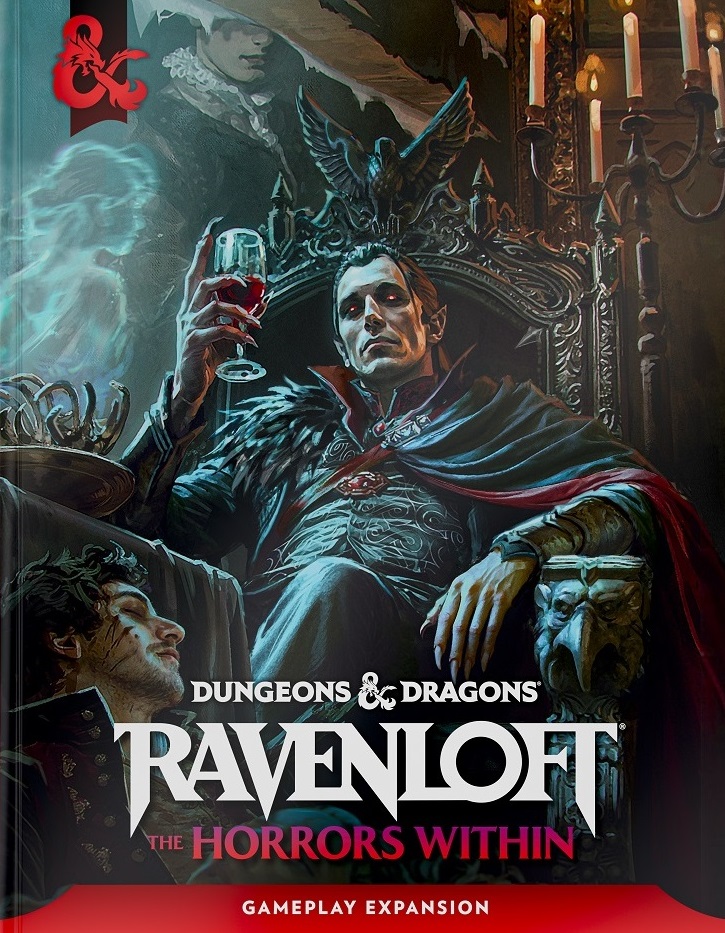
The cover for the conventional retail release features Ravenloft’s most famous resident, Strahd. The art is a classic gothic-style illustration by Anna Podedworna of Strahd, malevolent and somewhat miserable in the domain of dread that is his prison. The Ravenloft logo evokes the typography of the original Stephen King paperbacks and the like.
Photographs of the alt cover do not do it justice, which is not surprising. Wizards often uses metallic inks, iridescent effects and the like, which do not show up well even in the most careful commercial photography. In this case, photos make it look as if Pam Wishbow’s art is just rendered in black, red, and shades of gray.
In reality, the cover is stunning. Printed on silver paper, the art is rendered in a pointillism style with the black dots on silver paper creating the various shades of gray. The back cover art especially shows off this technique because it’s all black and silver.
The black portions are done that in that matte soft touch black frequently used in D&D alt covers and here, I do like that the artwork for each darklord has a quote on it that not only conveys the darklord’s personality, but could also serve as something they say when meeting the players. For example, the one for Ivana Boritsi is, “Your kind can’t possibly fathom how much this sort of interruption costs the House of Boritsi. Don’t make it worse by being tedious.”
it does a fantastic job of evoking the darkness of the void or the darkness intrinsic to horror. The red is a high gloss treatment in, of course, blood red, and in the Ravenloft logo it really pops against the matte black background.
The spine of the alt cover is has a gradient effect with silver lettering. At the base of the spine, it’s a red slightly darker than the front cover, as if a shadow is passing over blood red. It continues to darken going up the spine until it’s as black as Strahd’s heart at the top.
Otherworldly Art
AJ Hanneld as art project lead/senior creative lead, with art direction, by Emi Tanji did a fantastic job with the visuals for every part of this book. It would have been easy to do everything in a gothic style that screams “Transylvania,” and there is some classic gothic art, but it’s not the be-all and end-all. Instead, Hanneld and team went outside the box and sought inspiration from other styles of classic horror.
I love that some of the inspiration comes from the super saturated colors of Dario Argento/s original version of Suspiria. If you pay attention, the various domains have color themes to further play up their differences, but I really love that some of the color saturation art looks like its being viewed under black light. It enhances the surrealistic effect and the feeling that you’re dealing with something unnatural and unworldly.
Hanneld made sure that RtHW looks different than VRGtR on every level. Instead of a keyhole perspective to the art, we get full-bleed (pun intended) images that go to the page edge. The black pages with white text are gorgeous, evocative, and easy to read. The paper stock is a little different, too, to support the increased ink on the pages. RtHW is gorgeous and unsettling, creating a mood that is perfectly in keeping with horror movies from A24 and Neon or A24’s surreal The Green Knight.
The art evokes classic horror in other ways, too. For example, Leroy Steinmann’s art for the aberrant anatomy dark gift is very Peter Lorre-esque in appearance. The end paper design by Alix Branwyn makes me think of the wall paper design in a Victorian room where things aren’t quite right but you can’t quite figure out what until it’s too late.
The Accessories
D&D books typically come with optional add-ons, but what they are, who produces them, and how useful or even enticing they are varies widely. Because Ravenloft is so popular, RtHW has an expanded list of related products, from its usual partnership for miniatures from WizKids to dice from FanRoll and a whole range of products at Hot Topic. Here, I’m going to focus on the ones, like the Tarokka Deck, from Wizards itself: the map pack and DM screen.
I’ve been critical of Wizards’ DM screens in the past because too often, the priorities were wrong, omitting things a DM needed in favor of themed charts that are rarely used. I loved the trinket tables from the 2014 PHB and that they were continued in many adventures (Hey Wizards, keep doing them! Players love them.), but it’s an utter waste of space on a DM screen.
The RtHW DM screen, thankfully, does not fall into that trap. One panel defines conditions. One panel is a d100 themed encounter chart with an associated Tarokka card. The other two panels have charts defining types of actions, covering distance, improvising damage, rules for long rests, concentration, and death saves, object armor class, object hit points, skills and their associated ability scores, task difficulty Dcs, cover rules, obscured areas, light sources, and sampel costs for food and lodging. That’s an excellent, useful roundup of things a DM needs regularly.
Even when I criticized the the content of the DM screens, the art is usually quite good. For RtHW, the art side of the screen is stellar. It has a texture similar to the soft touch effect used in the matte black of the book’s alt cover, but this art is a riot of color, not just continuing the saturated color schemes from the book, but, because there is an iridescent effect, it has the look of unnatural light used in some horror movies. This art is more effective than usual for reminding players of the setting.
The RtHW Map Pack is actually a map and token pack, which is smart. So is the fact that the maps can be used for any horror or creepy situation. It has 5 double-sided battle maps on good quality paper for locations like haunted house, hallowed ground, and witch’s hovel. So this map pack doesn’t have, for example, Castle Ravenloft, but that’s been covered in other releases. The 93 tokens included are a mix of creatures and terrain. It’s a good, solid, multi-purpose set
Ultimately, I’m glad Wizards finally did things with RtHW that I thought they should have done ages ago. That includes prepping the audience for it in advance with an actual play campaign tied to it before its release, and including supporting materials like the map pack, DMs screen, and Tarroka cards. Wizards has done actual play campaigns before, too, but they’re not consistently related to an upcoming or current release. I know it takes a ton of work, but the promotional benefits seed interest for an upcoming release.
Yes, Curse of Strahd’s release also offered Tarokka cards, DM screens are often available (but sometimes through third-party licenses), and maps have sometimes been available separately (again, sometimes through third parties or the cartographer’s website), but why did it take so long to put together a cohesive suite of related products from Wizards itself and promotion through a coordinated actual play campaign? And will they now do that with the next release? Or is this a one-off? Or test case? I guess time will tell.
So long as we are not REQUIRED to buy the supplemental products for the adventure to run properly and any supplemental products are truly useful, I say go for it. They’ll never match sales numbers for its accompanying book, but produced thoughtfully and with realistic expectations, supporting products can be a win/win for DMs and Wizards.
Hint for Wizards: For an adventure book, I’d love to see a deck of NPC cards so I could easily show my players what the NPC looks like and have a quick summary of the NPC’s personality and goals on the back.
Conclusions
I like a lot of RtHW and have zero problems with Ravenloft getting another book. While I am happy overall with the fact that Wizards has decided to avoid the “flood the market” approach it used in 4E, releasing two books a month, its careful 5E release pace means that some settings have only had one book release so far, and some, like Mystara and Birthright, haven’t had any. I also love the idea of taking the horror deeper so that VRGtR is the 101 on D&D horror in general and Ravenloft in particular, and RtHW functions as the 202 level.
I can also understand why RtHW repeated some of the material from VRGtR, but that’s also asking for complaints. As I said above, it puts Wizards in a no-win situation. Revisiting Ravenloft with an adventure book or an adventure anthology that also had the new and revised player options would have been, in my opinion, a less controversial choice.
It also bothers me that, while most of the reused material is rewritten, some things aren’t, but the original writers are not directly credited. Instead, they’re covered by a general thanks to the VRGtR team. I’d prefer a “special thanks” box that actually gave their names.
While visually, RtHW is stunning and cohesive, I feel like they couldn’t quite decide what the written content should be, giving RtHW a bit of an identity crisis. A revised and updated replacement for VRGtR is fine, but this was promoted as the advanced version of D&D horror that built upon the 101 approach of VRGtR. This particular mix of updating past material, omitting some, and adding new material somehow only partially achieves that goal of offering a deeper exploration of horror,
I like the actual new content itself. The mechanic for having a darklord speak through a Tarokka card reader under certain conditions is a great idea. I love the flavor of the Hollow Warden ranger and Reanimated Artificer but have mixed feelings about the mechanics for the latter. I might like it better after actually playing it.
The advice for running horror and taking it further is good and important. I don’t love that a lot of it is a repeat, and I definitely miss the Horror Toolkit from VRGtR.
Overall, I found RtHW frustrating. I really like a lot of it, and it’s one of the best looking D&D books ever, hands down. But it borrows so much from VRGtR that, even though the bulk of it is rewritten and revised, it feels more like a remix than the successor promised or a companion volume.
When reviewing a D&D release, I mentally put myself into the head of several types of potential buyers, like the long-time D&D player/DM, the newcomer, the person who is fan of the setting or genre, someone exploring it for the first time, etc., and ask if this book would satisfy me, excite me, and so forth. As good as RtHW is, it could frustrate both new DMs and long-term ones.
The person who already owns VRGtR would likely want and enjoy the new material (Cthulhu and Inssmouth, guidance on how to use the Tarokka deck better as a prop in the campaign, bastions, etc.), but then might be annoyed to find other content familiar. The person buying their first Ravenloft book and trying to choose between the two loses things like the Horror Toolkit, expanded descriptions of certain domains of dread, etc. if they go with the new book and misses out on bastions, new player options, the new domains of dread, etc. if they go with the earlier book.
Obviously, on a corporate level, Hasbro would like people to buy both books. I think a better delineation between the two would have made that an easier choice for fans.
The mix of excellent content, including the outstanding art and art direction (those black pages were ambitious and work beautifully), with the disappointing repeats and muddled purpose means that I’m only giving Ravenloft: The Horrors Within a B rating. Ravenloft: The Horrors Within DM Screen: A+. Tarokka Deck (combined with advice for using it in the book): A. Ravenloft: The Horrors Within Map Pack (and tokens): A